

Crystal T’ai Chi © - All Rights Reserved. Page updated 25 April 2016

This Site is regularly updated. If you spot any problems or missing links please let us know.




T’ai Chi for Arthritis & Back Pain
“T’ai Chi for Arthritis” is Dr Paul Lam’s flagship program for his T’ai Chi for Health series, and has been used successfully all over the world for over a decade. Based on a modified version of the Sun form it increases mobility and balance to aid the treatment of arthritis.
Since its introduction, a seated variant and one to help Back Pain have been developed.
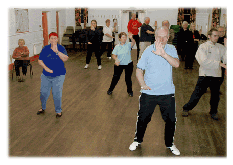
We are trained instructors for TCA and use it as an introductory form for all our classes.
View our article “How T’ai Chi helps with Arthritis”


The Arthritis Foundation of Australia has stated that arthritis affects more than 16.5% of Australians. This is probably too low in view of the US state-by-state survey of arthritis and chronic joint symptoms from the Center for Disease Control and Prevention (CDC) report, October 2002. It shows that one in three American adults are affected.
A study published in the September 2003 issue of “The Journal of Rheumatology” shows T’ai Chi
improves arthritis. Arthritis is the No. 1 cause of disability. It is now a national health priority, according to the president of the Arthritis Foundation of Australia, Ita Buttrose. The overall financial cost of arthritis to business is around
$9 billion annually. A newly published study has shown that the low-tech and low-cost ancient art of T’ai Chi improves the condition by 29-35% within three months. Conducted by three Korean professors and Dr Paul Lam with the collaboration of two universities and one major hospital, it is the largest randomised study of its kind. Based on the 12 forms of Sun-style T’ai Chi (created by Dr Paul Lam and a team of T’ai Chi and medical experts), the study found that after only 12 weeks, the arthritic symptoms, balance, and physical functioning of older women with OA were greatly improved. The study has shown that after three months, patients have 35% less pain, 29% less stiffness, 29% more ability to perform daily tasks (like climbing stairs), as well as improved abdominal muscles and better balance.
View the study published in the September 2003 issue of “The Journal of Rheumatology.”
Back Pain
T’ai Chi programs such as the one modified for Arthritis, strengthens the deep stabilising muscles of the back.
According to new medical findings, the deep muscles close to the spine stabilise and protect the spine Strengthening them will reduce pain and improve physical function.
Read Trevor’s article on Back Pain
published in Dr Lam’s Jan 2011 Newsletter
| Sifu Trevor |
| Assistants |
| Find a Session |
| Workshops |
| Events |
| Tai Chi for Energy |
| Talks |
| 1to1 Tuition |
| Our Classes |
| Training Us |
| Events & Workshops |
| Sword & Fan |
| Kidz |
| My Favourite Place |
| Info & Articles |
| Videos |
| Useful related websites |
| Testimonials |
| A T'ai Chi Poem |